ALFA
ROMEO TAKES ROUND ONE
December 26, 2009
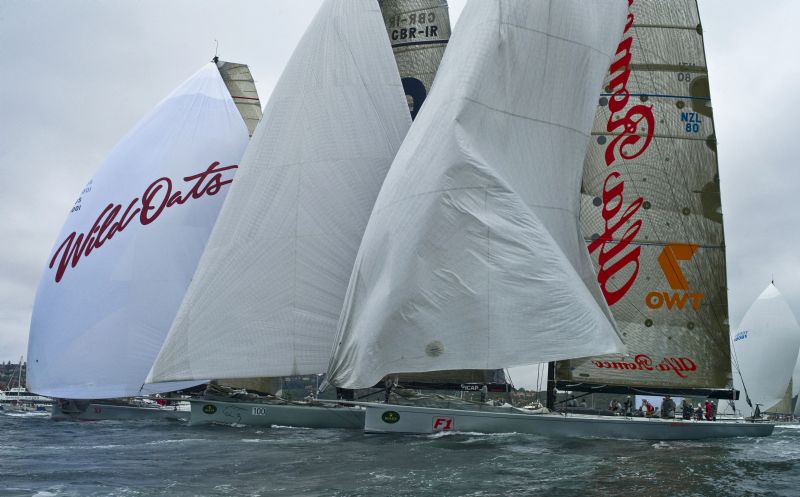
Neville Crichton's Alfa Romeo took round
one of the battle of the maxis at the head of the 2009 Rolex
Sydney Hobart Yacht Race with smart downwind tactics in Sydney
Harbour.
After a two nautical-mile spinnaker run
from the start off Shark Island, before a 10-knot south-southwesterly
breeze, Alfa Romeo rounded the first clearing mark at Sydney
Heads 30 seconds ahead of her near-sister Reichel/Pugh 100 design
Wild Oats XI (Bob Oatley), with another 20 seconds to the British
Farr 100-footer ICAP Leopard (Mike Slade).
These three strongly-sailed, professionally-managed
maxis are favoured to lead the fleet into Hobart, 628n miles
from the start.
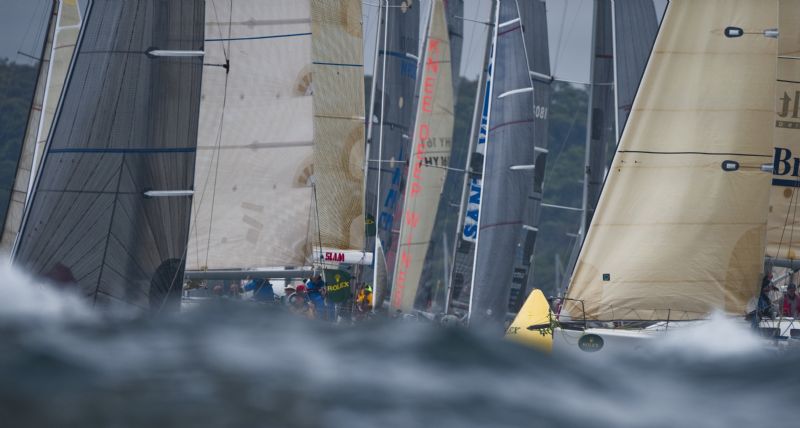
Manoeuvring these giants for a downwind
start among the smaller boats in the 100-boat fleet was challenging.
With a minute to go, Alfa Romeo was caught ahead of the line
and had to re-round to start on the gun.
Wild Oats XI, with speed and a smart spinnaker
set, showed out as the early leader from a clear start near the
middle of the long starting line spanning nearly the width of
the harbour, followed closely by ICAP Leopard.
Alfa Romeo, starting nearer to the line's
pin end, sharpened up with pace to gain an overlap to leeward
on Leopard. Off Watsons Bay on the harbour's eastern shore, Alfa
gybed away first on a patch of good pressure breeze; Wild Oats
XI and Leopard followed. But as Alfa Romeo gybed again and came
back fast on starboard gybe, she cleared them both to round the
mark between the Heads clear ahead.
From there Alfa comfortably held her lead
in a procession over the one nautical mile reach to the second
clearing mark, another mile to seaward.
As the fleet then sheeted on to head south,
another procession developed. Starboard tack on about 155 degrees
was by far the gaining leg towards not only Hobart, but the favourable
flow of the Eastern Australian current, so tacking away on to
port and heading inshore was not an option for the boats behind
Alfa.
Next to round the seaward mark was another
100 ft maxi, Investec Loyal (Sean Langman), followed by the UK
Judel/Vrolijk 72 Ran (Niklas Zennstrom), which is one of the
favourites to take the race's major prize, the Tattersall's Cup,
for the overall winner on IRC corrected time.
She was followed by Lahana (Peter Millard/John
Horan), the Brett Bakewell-White 98, ex-Konica Minolta; Rapture,
Brook Lenfest's 100ft Farr performance cruiser from the USA;
Limit, the Reichel/Pugh 62 (Alan Brierty); Ludde Ingvall's Simonis
Voogd 90 YuuZoo, which took line honours in 2004; the R/P 63
Loki (Stephen Ainsworth); R/P 55 Yendys (Geoff Ross) and the
Farr 55 Living Doll (Michael Hiatt).
Grant Wharington's Jones 98 Etihad Stadium
(ex-Wild Thing) retired with rig problems soon after starting.
It was a near-miracle that Etihad Stadium even made the start
after a two-week around-the-clock effort by crew members, mast-makers,
and riggers to replace the mast broken on the delivery voyage
from Melbourne.
The mast, a rebuild of a spare acquired
from Neville Crichton, had to be cut in two for air-freighting
from France to Sydney and re-rigged just in time for Etihad Stadium
to get to the start line today without time for any testing under
sail.
Wharington explained that ten minutes before
the start, the crew discovered that the finely-tuned mast could
not be kept in column. Misalignment of the runner blocks from
the old rig meant that the runner tension of up to 15 tons could
not be maintained.
"It was an incredibly tight set of
circumstances and we needed everything to fall into place with
100 per cent agreement on everything to go to Hobart," Wharington
said. It's an amazing feat to get to where we got, obviously
disappointing just to miss out by the last one or two percent.
"I am enormously disappointed obviously
and for my team more than anything because we've had probably
50 people working on this for the past two weeks and an enormous
amount of input from every single person."
Another sad retirement was the Inglis 39
She's the Culprit (Todd Leary) from Hobart, seriously holed on
the long journey home in a collision with another competitor
(as yet unidentified) soon after the start.
Untypically for Sydney at this time of
year, Boxing Day was wet and cold, which greatly reduced the
size of the spectator fleet. Though with this came the benefit
of also reducing the crush of powerboaters that often disrupt
the fleet with their wakes once past the outer sea mark, which
is beyond the spectator control areas inside the harbour.
Five hours after the start, with the sou'-wester
freshening to 25 knots and a difficult short chop developing
offshore, the Cruising Yacht Club of Australia's satellite yacht
tracker system showed Alfa Romeo still leading by a mile from
Wild Oats XI, which was just 0.2nm ahead of ICAP Leopard.
The 100-boat Rolex Sydney Hobart
Yacht Race fleet (including two yachts officially retired) has
crews representing the USA, UK, New Zealand, Spain, the Netherlands,
and New Caledonia as well as every Australian state.
ALFA ROMEO STILL LEADING LIGHT-AIR DRAG RACE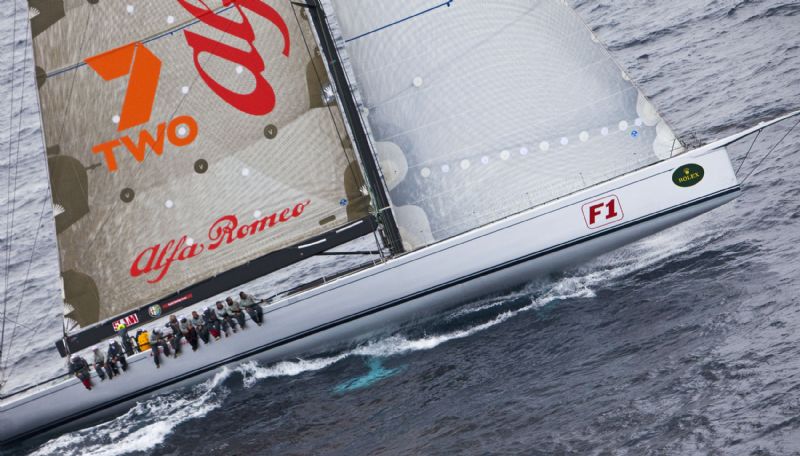
December 26, 2009
Neville Crichton's Alfa Romeo remained
in control of her nearest maxi opponents through a changing wind
pattern overnight and into the second day of the 2009 Rolex Sydney
Hobart Yacht Race.
Alfa's afterguard, including tactician
Michael Coxon and navigator Tom Addis, kept the yacht perfectly
positioned at the head of the fleet to be first into the anticipated
shift in wind direction from south-southwest experienced from
the start to southeast off the south coast of New South Wales.
Alfa Romeo tacked on the shift at about
2145 last night to converge back towards the coast on port after
the long gaining starboard tack the fleet followed after clearing
Sydney Harbour from the 1300 start.
At 0800, 19 hours into the race, the Reichel/Pugh
100 was 24 nautical miles northeast of Green Cape, 2 miles ahead
of Mike Slade's Farr 100 ICAP Leopard, which was three or four
miles to seaward, with another 2nm to Bob Oatley's Wild Oats
XI, a near sister design R/P 100 to Alfa Romeo. Alfa had covered
193nm of the 628nm course and was doing 10.8 knots.
All three were close to the shortest-distance
rhumb line between Sydney and Tasman Island and on course for
the island, but were starting to slow as the wind dropped from
its 25 knot peak of last evening to 10-12 knots and less this
morning.
Critical for all boats will be traversing
the light airs and calms expected today in the Bass Strait, between
the Australian mainland and Tasmania, before a forecast 20-30
knot westerly change tonight.
Wild Oats XI navigator Ian Burns said this
morning: "The wind is pretty light now, between 6-10 knots
and quite variable. The seas are flatter - it was a little rough
at times last night.
"We've had quite a few wind shifts
and some big lulls. At one stage the guys behind us [Ran and
Lahana] ran almost up to us. We exchanged some tacks as the southeast-southwester
fought it out but it has been hanging in the southeast for some
time now.
"Some forecasts are calling for no
wind at all across half of Bass Strait. The fact that we will
head butt into the light stuff gives us a bit of a chance. Leopard
is doing a great job for a big boat in the lighter wind, but
the race hasn't really started yet; that will be today."
The overall handicap leader on IRC corrected
time is Michael Hiatt's Farr 55 Living Doll over the UK-based
Judel/Vrolijk 72 Ran (Niklas Zennstrom), followed by the Jones-modified
Volvo 70 Ichi Ban (Matt Allen).
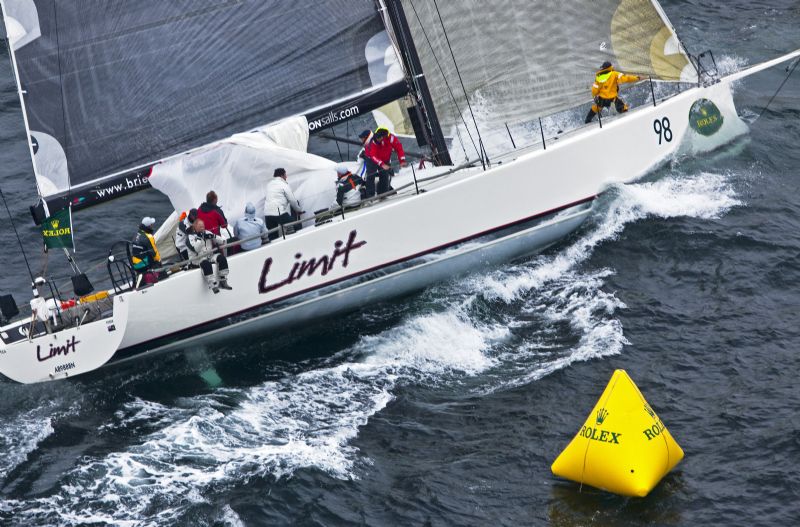
One of the handicap favourites, Alan Brierty's
Reichel/Pugh 62 Limit, was among the retirements overnight due
to problems with the halyard locks.
That brings the number of retired
yachts to four in the 100-boat fleet that started yesterday from
Sydney. The Rolex Sydney Hobart Yacht Race fleet has crews representing
the USA, UK, New Zealand, Spain, the Netherlands, and New Caledonia
as well as every Australian state.
STOP-START TO HOBART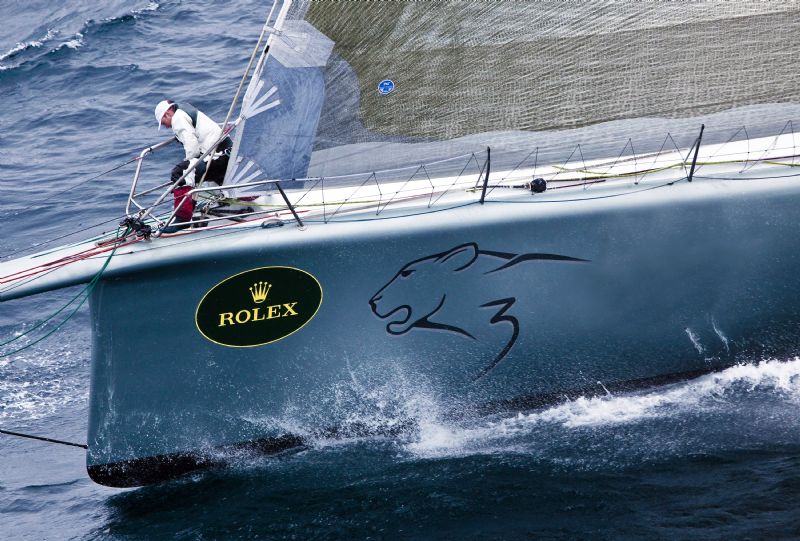
December 27, 2009
The Rolex Sydney-Hobart race fleet leaders
stalled and stopped in calms off the far south coast of New South
Wales earlier today. The smaller boats came up on a developing
coastal sea breeze while the maxi leaders and 50-60-footers were
stuck inshore this morning, trying to struggle around Green Cape
and Gabo Island at the entrance to Bass Strait
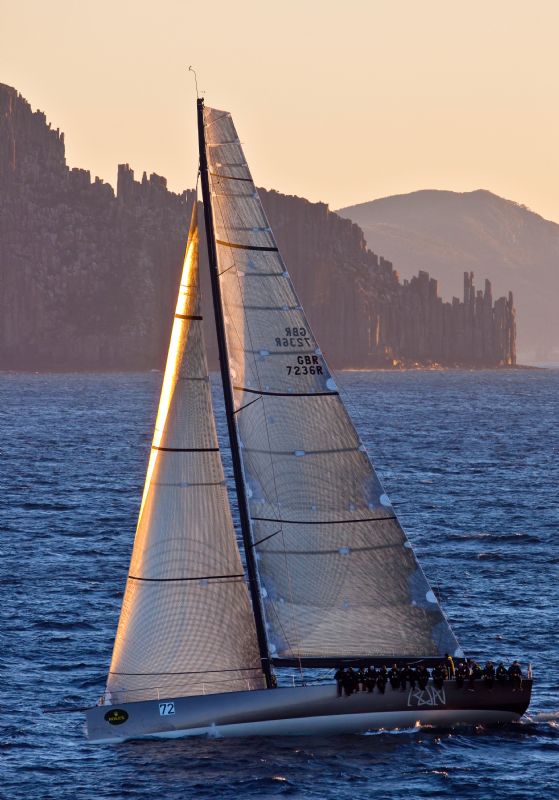
Neville Crichton's Reichel/Pugh 100 Alfa
Romeo, which had led the race from Sydney Heads, was first of
the three leading maxis to struggle into new pressure to pass
Green Cape and sail to the west of the rhumb line (straight distance)
course from Sydney to Tasman Island.
Alfa Romeo took off on a two-sail reach
in a freshening east-northeaster and by 1800 was well into Bass
Strait, 58 nautical miles south of Gabo Island with 330nm to
go to the finish.
The three leading maxis were achieving
extraordinary speeds in only 10-12 knots of breeze and on course
for Tasman Island, the last major rounding landmark on the 628nm
course.
Alfa Romeo, making 16.7 knots, was 16nm
ahead of ICAP Leopard, the British Farr 100-footer owned by Mike
Slade, with Bob Oatley's Wild Oats XI, a very similar Reichel/Pugh
100, another 2nm behind Leopard and closing the distance. Wild
Oats XI was making 16.7 kn to Leopard's 16.2kn.
While these are very respectable speeds,
the weather forecasting models are in agreement there will be
more calms and light patches ahead. Respected yachting forecaster
Roger Badham, who provides pre-race weather predictions to many
top boats in the fleet, says: "The big guys will have some
running in Bass Strait this afternoon, but there are still a
lot of potholes between that and the finish," Badham said.
"Anyone of the three could finish first."
One certainty is that Wild Oats XI's race
record, set at one day, 18hrs, 40mins, and 10secs in 2006, is
in no danger. Given the calculations of speeds so far, Alfa would
be expected to finish at 2030 Monday night, with Leopard and
Wild Oats XI finishing after midnight.
But a westerly change turning moderate
southwesterly is predicted for Tasmanian waters tomorrow - and
that could still create those potholes of calm and light patches
off the east coast under the wind shadow of Tasmanian's high
interior.
From Alfa Romeo, Murray Spence reported,
as she picked up the light nor'easter, "We are now enjoying
the sunshine; not the usual way to cross Bass Strait." He
said the crew was driving the boat hard today, although they
were keen to get some rest after reefing most of the night had
meant "intense work from all on board".
Wild Oats XI skipper Mark Richards said
Oats had been within three or four miles of Alfa Romeo in the
morning calm before Alfa accelerated out of sight in the first
of the new breeze. "There's always the element of luck in
these races and right now it has gone his (Alfa's) way and not
our way. But there's a long way to go, so anything can happen
yet," said Richards. He said the attitude on the boat remained
very positive. "We have a fantastic bunch of guys on board
here; we won't give up 'til the death."
Adrian Stead, tactician on the British
Jude/Vrolijk 72 Ran, the 2009 Rolex Fastnet Race winner, was
upbeat even though the light conditions are not expected to suit
this powerful boat. "We are just past Green Cape and the
breeze is filling back in. We have done okay with the current
but had a light morning. It's nice to still see the maxis, but
we are conscious of boats behind using the sea breeze this afternoon."
The concertina effect completely scrambled
the IRC corrected time calculations. The new IRC overall leader
is reckoned to be Noel Cornish's Sydney 47 Jude, crewed by a
group of friends from the Cruising Yacht Club of Australia.
The Sydney 38, Mondo, retired today
with rigging problems and was heading to Eden, bringing the number
of retired yachts to five, with 95 yachts still racing. The Rolex
Sydney Hobart Yacht Race fleet has crews representing the USA,
UK, New Zealand, Spain, the Netherlands, and New Caledonia as
well as every Australian state.
THE RICH GET RICHER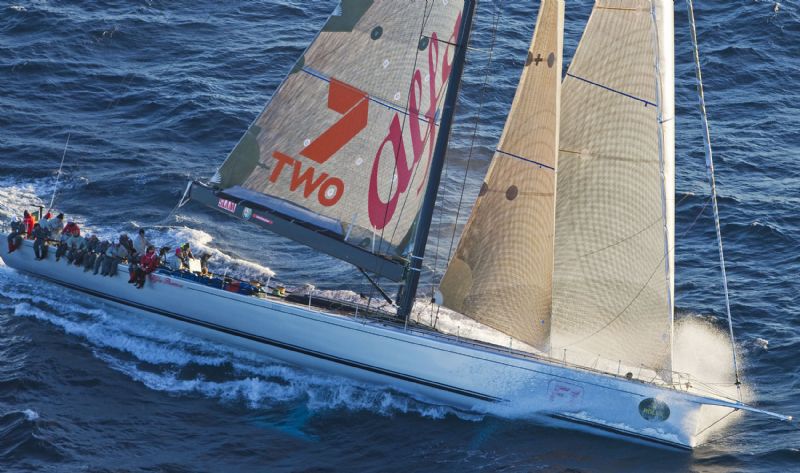
December 27, 2009
The maxis leading the Rolex Sydney Harbour
race fleet cleared a barrier of light air and calm in Bass Strait
in the early hours of this morning to reach away on a new westerly
flow at speeds of up to 20 knots.
Race leader Alfa Romeo, a Reichel/Pugh
100 owned by Sydney-based New Zealander Neville Crichton, first
to clear the calm-creating ridge of high pressure to the north
of Tasmania, opened a healthy lead of 30 nautical miles on her
nearest maxi opponent for line honours, Mike Slade's Farr 100,
ICAP Leopard.
At 0700 Alfa was 22nm east of St Helens
on Tasmania's northeast coast, doing 14 knots and on course for
Tasman Island, 41nm from the finish. She had 150 miles to sail
and, at the present time, is expected to finish in the early
evening.
ICAP Leopard, making 16.7 knots, was still
three miles ahead of the race record holder Bob Oatley's R/P
100 Wild Oats XI.
Alfa Romeo was not only on track for the
line honours win; computer calculations had her leading the race
for the Tattersall's Cup, the race's major prize for the overall
winner on IRC handicaps.
Alfa, Leopard and Oats had gained a huge
jump on the rest of the fleet. The fourth boat, Sean Langman's
Elliott 100 maxi Investec Loyal, was 80nm behind Wild Oats XI,
51nm east of Flinders Island making 9.2 knots; much slower than
the leading trio.
Tom Addis, Alfa's navigator, said: "We
got the ridge pretty well. It's always stressful going through
transitions like that but we did as much homework as we could
and it all went to plan. Our aim was to be first boat out and
cross (the ridge) at the narrowest point. We made big gains on
the way out."
Ian Burns, co-navigator of Wild Oats XI,
said: "We managed to cross the ridge as it was spreading
up. We drove west to get around it, as did Alfa and Leopard;
we never slowed more than six or seven knots. The guys behind
us got swallowed and are still there. "We were last through
the gate. Alfa gets richer and richer, looking like a handicap
winner, too. It was a very calm night, pretty warm with a nice
moon. And now new breeze is coming in quite nicely from the Banks
Strait (northeast of Tasmania)."
Burns warned that the leaders face one
more difficult wind situation in the lee of Tasmania. Tasmania's
high interior splits westerly flow into a nor'wester around the
north of the island and a sou'wester around the south.
"We have one more transition to go,
when the northwesterly meets the southwesterly," said Burns.
"But Alfa hasn't made a missed step yet and they are unlikely
to. So far, the race has favoured the leaders and in all probability
will continue to do so."
Five yachts have retired to date,
and there are 95 yachts still racing. The Rolex Sydney Hobart
Yacht Race fleet has crews representing the USA, UK, New Zealand,
Spain, the Netherlands, and New Caledonia as well as every Australian
state.
Alfa Romeo leads fleet
on all counts
0700hrs, 28 December 2009
As Alfa Romeo surged down the Tasmanian
coast at 7am this morning she was leading the Rolex Sydney Hobart
on two fronts: line honours and IRC handicap. The lead she has
opened up on the other maxis is so large that the New Zealand
maxi is almost sailing a race of her own.
At that time it was not the other maxis
that were lining up behind her in the handicap stakes, it was
a bunch of 40 footers 130 miles astern of her which had barely
poked their noses into Bass Strait.
Ed Psaltis and Bob Thomas’ Farr 40
AFR Midnight Rambler was lying in second place overall, followed
by the New Caledonian Archambault 40 41Sud, sailed by Jean Luc
Esplass, and Anthony Paterson’s Ker 11.3 Tow Truck.
These smaller boats should enjoy a lively
20 knot westerly across eastern Bass Strait today, which should
greatly improve their time against Alfa Romeo, but they are also
likely have to race in a southerly all the way down the Tasmanian
coast. What the gods give they take away.
At this stage in the race for the Tattersall’s Cup for the
overall winner, the grand prix 50 and 60 footers are doing it
tough. The best placed in eighth position is last year’s
winner, Bob Steel’s TP52 Quest, but unlike the little boats
behind, the 60 footers have had to contend with the big hole
above Flinders Island overnight.
They will have southerly winds most of
the way down the Tasmanian coast and could arrive at Tasman Island
for the final turn after the notorious midnight ‘shutting
of the gate’, when the wind dies and Storm Bay and the Derwent
River become very quiet places to park indeed.
Just after 6am this morning John
and Kim Clinton’s Holy Cow! was 35nm SE of Gabo Island and
had just entered eastern Bass Strait with a huge escort of dolphins,
“the cute little two tonne ones” according to Kim.
“Great sunrise, beautiful conditions after a really quiet
night. Seems so benign at present. Wish our dog was with us now,
she just loves dolphins.”
Fickle
race stretches crews’ patience to its limits
1200hrs, 28 December 2009
On day three of the 65th Rolex Sydney Hobart,
it’s not just the skills and endurance of the crews that
are being tested; they need the patience of a saint.
Depending where they are on the racecourse,
some yachts are fairly skipping along, and others are barely
moving.
At the back of the fleet, just breaking
away from the mainland coast, the smaller, slower boats are enjoying
a handy breeze after a long and at times frustrating beat down
the NSW coast. But the further into Bass Strait the fleet pushes,
the lighter the breeze gets, and in the middle it all but disappears.
“We are in a parking lot,” Michael
Bellingham, the navigator of Stephen Ainsworth’s normally
super fast Reichel/Pugh 63 Loki reported. “It’s time
to break out the cards.”
Sailors with disAbilities, a Lyons 54 design,
is about a third of the way across the Strait. In a phone call
late this morning, skipper David Pescud reported: “It’s
like a millpond, but we’re happy with our four and a half
knot boat speed, given the conditions. What little breeze there
is is shifting to the south. It’s weird. We’re used
to having 10 metre waves trying to chop our heads off.
“If it wasn’t a race it would
be beautiful sailing. It’s become a very tactical race,
but it’s so slow. It’s given us a lot of time to think,
it’s like a giant game of chess.”
The lull has stymied the highly touted
50 to 70 footers all morning as they struggle to keep up with
the leading maxis on handicap.
The race leaders, super maxis Alfa Romeo,
Wild Oats XI and ICAP Leopard, were affected by it off Flinders
Island during the night, but were still able to keep up some
momentum. The gate really closed as Wild Oats XI broke out on
the southern side and found a bit of breeze. As is so often the
case in ocean racing, the rich are getting richer and the poor
more philosophical.
“It has been a little frustrating
watching the big boats pass through unscathed,” said Will
Oxley, the navigator on Geoff Ross’ Reichel/Pugh 55, Yendys.
“Behind us the fleet is closing on us but we are hoping
for the first in first out theory in lulls to keep on working.”
The good news is that there is some breeze on the other side
of the calm, and the boats are picking up speed as they close
in on Flinders Island, though nothing like the double digit speeds
they have been recording.
As the yachts move down the Tasmanian coast
there is another hole around Maria Island lying in wait. The
lead maxis were reaching 20 knots very early this morning as
they raced past Eddystone Point on the Tasmanian north east coast,
but they have been steadily slowing the further south they have
ventured.
This whole race has become a matter of
avoiding the lulls and holes and because it has been so slow,
a true test of patience and crew management.
Crews spent the early part of the race
on the rail, cold and wet, and lately, scouring the horizon looking
for wind. Managing the watches and ensuring that everyone gets
enough rest has become a key factor. Tired crews can make bad
decisions.
Logistical management is also coming into
unexpected play. On the grand prix racers, weight is everything,
right down to the amount of food and water allotted to each crew
member. Many of the racing crews get by on freeze dried food,
nuts and Mars Bars - and a happy skipper is one who hasn’t
lugged an extra sandwich all the way to Hobart for nothing.
But this race is taking a day longer than
envisaged.
“We have started to ration
water to make sure we have enough for this extended Rolex Sydney
Hobart race,” Yendys’ Oxley says. “The trimmers
are no longer allowed to pour fresh water over their winches
to keep them quiet. No tea or coffee overnight.”
Wild Oats XI closing -
but is it too late?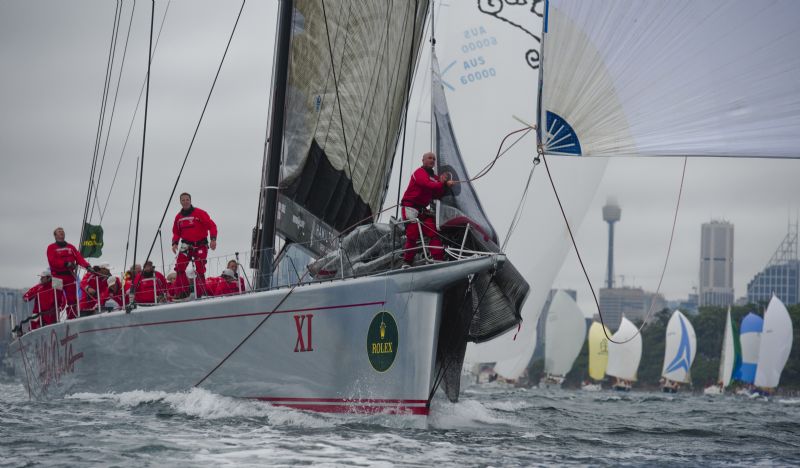
28 December, 2009 2:00:00 PM AEDT | Racetime 02:01:00:00
Should Neville Crichton get his hands on the highly prized Tattersall’s
Cup, his New Zealand supermaxi would be only the seventh boat
in the history of the Rolex Sydney Hobart Yacht Race to take
the double of line honours and the overall winner on corrected
time.
Alfa Romeo continues to lead the race half
way down the Tasmanian east coast, 13 nautical miles ahead of
four-time winner Wild Oats XI, which has gathered in the British
maxi ICAP Leopard and opened up a gap of 19 nautical miles for
second place. All three are making about 11 knots.
The problem for all three, but particularly
the frontrunner, is that there are light, variable winds as they
close on Tasman Island. If Alfa Romeo falls into a hole, the
Mark Richards skippered Wild Oats Xl will be forewarned.
A short time ago, Alfa Romeo lost the handicap
lead to the British yacht RÂN, which is going for the Rolex
Fastnet and Rolex Sydney Hobart corrected time double.
The bulk of the fleet is experiencing light west to south-westerly
winds of 10-15 knots as they cross Bass Strait with winds expected
to pick up to 20 knots and stronger as the yachts approach Flinders
Island. But overnight, further south, the winds off the coast
will be light and variable and yachts will be greeted with early
sea breezes from the south-east.
The bad news for the frontrunners is that
the forecast for the Derwent estuary tonight are north-westerly
winds at 10-15 knots, which are expected to fade.
The experience of Englishman Mike Slade’s
ICAP Leopard is symptomatic of the frustrations of the fleet.
“We’re all going through this
north easterly/south easterly transfer area off Cape Forestier,”
Slade said a short time ago.
“At the moment we have 3.3 knots of
wind speed and 3 and a half knots of boats speed, but it goes
up and down. I’ve seen two knots and I’ve seen six
knots of both wind speed and boat speed. It is very hard work.”
ICAP Leopard is further out to sea than
her two rivals, and intends to stay that way.
“Both Alfa and I can lay Tasman Island,
but it is going to take a long time and I suspect there are more
funny things going to be thrown at us by the wind gods before
we get there,” Slade said.
Slade thinks it will be midnight or 1am
before ICAP Leopard gets to Tasman, not an ideal time to arrive.
“Most people in Hobart go to bed early,
and they do that mainly because there is no wind,” he quips.
While Alfa Romeo has got the jump on the
other maxis, ICAP Leopard has had an enthralling dual with Wild
Oats XI all the way from Sydney, the British yacht getting the
better of it for most of the time.
“We are thrilled at how well the boat
has gone in very, very light air conditions,” Slade says.
“We did work hard on the boat after losing out to Wild Oats
XI in light air in 2007, but this has been stop start all the
way.
“Working in light air like
this for three or four or five days, as some of the other boats
will do, is tough enough, it really is. We’ve done five
sail changes in the last hour and a half, and that’s pretty
exhausting,” he said.
Alfa
Romeo holds on to Rolex Sydney Hobart lead
Despite a lead of about 14 nautical miles over four-time line
honours winner Wild Oats XI, and only 70 nautical miles to go
to the finish of this year’s Rolex Sydney Hobart Yacht Race,
Alfa Romeo skipper Neville Crichton is leaving nothing to chance.
“We will cover them whenever we possibly
can,” Crichton told the Rolex media centre by satellite
phone as the super maxi closed to 30 nautical miles on Tasman
Island mid-afternoon.
“We won’t let her go out on a
flyer without us being there,” the New Zealand businessman
said.
In effect, Crichton is warning Wild Oats
XI that it will be a match race to Hobart from this point on.
If the Mark Richards skippered Wild Oats
XI changes her course, or strategy, Alfa Romeo will cover Bob
Oatley’s yacht, but from the front.
In sailing terms, it means that Crichton
will seek to ensure that the two recently modified yachts, which
are virtually identical, stay in the same weather and wind pattern.
Crichton said he was expecting the wind
to move to the south at Tasman Island, which the Hobart weather
bureau has just confirmed.
Forecaster Malcolm Downing said the leading
boats would face a south-westerly of 10 knots, gusting to 18,
at Tasman and the wind would then veer to the west and north-west
as they crossed Storm Bay and into the Derwent River, where the
north-westerly would ease from 15-20 knots to 10-15, but, importantly,
the wind would stay in.
“This race has been much more difficult
than a windy race, there’s so much more to think about.
The winds have been so variable and so up and down,” said
Crichton, who would not be drawn on what time he would finish
the race and whether he would be first over the line.
As Crichton was speaking, Wild Oats XI was closing the gap in
the Cruising Yacht Club of Australia’s annual 628 nautical
mile race.
The Rolex race site tracker has Alfa Romeo
possibly finishing at approximately 10 o’clock this evening.
During the day, the British super
maxi ICAP Leopard, owned and skippered by Mike Slade, conceded
second place to Wild Oats XI and is now about 28 nautical miles
off the lead and sailing east of the rhumbline searching for
more breeze.
Wallaby
flanker turned sailor
The all-star cast aboard the 100 footer Investec LOYAL - Olympic
swimming gold medallist Grant Hackett, boxer Danny Green, HSBC
Waratahs captain Phil Waugh and former rugby union player Phil
Kearns – are getting the taste for ocean racing, so much
so they are talking about signing up for next year’s Rolex
Sydney Hobart before they reach the finish line of this year’s
race.
“We’ve discussed 2010,”
Phil Waugh said this afternoon as he spoke glowingly of their
experiences since leaving Sydney on Boxing Day.
“It got pretty heavy all of a sudden
yesterday,” he said. “And the last hour has been really
good.” (They were sailing at over 20 knots).
“All the guys are loving it,”
he said.
The Wallaby flanker, fresh from preparing
120 Vegemite rolls for the crew before they set sail, “to
put some fuel in the tank”, has settled down to a menu of
curries and spaghetti bolognaise as he literally learns the art
of winding winches.
He aired his new lexicon of nautical terms,
informing the listening media at the Rolex media centre in Hobart
this afternoon that the cable attaching the port helm to the
rudder had broken, forcing skipper Sean Langman to the starboard
wheel while repairs were made.
Investec LOYAL’s navigator David Dickson
confirmed that a strop between the rudder quadrant and the rudder
itself had chafed and broken, but a replacement had been spliced.
Dickson said their strategy coming
down the coast, running before a NNE wind of 19-25 knots, was
to sail under a jib top and staysail before setting a spinnaker
to bring the bow down and to cross the southern end of Maria
Island before making for the turning mark at Tasman Island.
ONE MORE HURDLE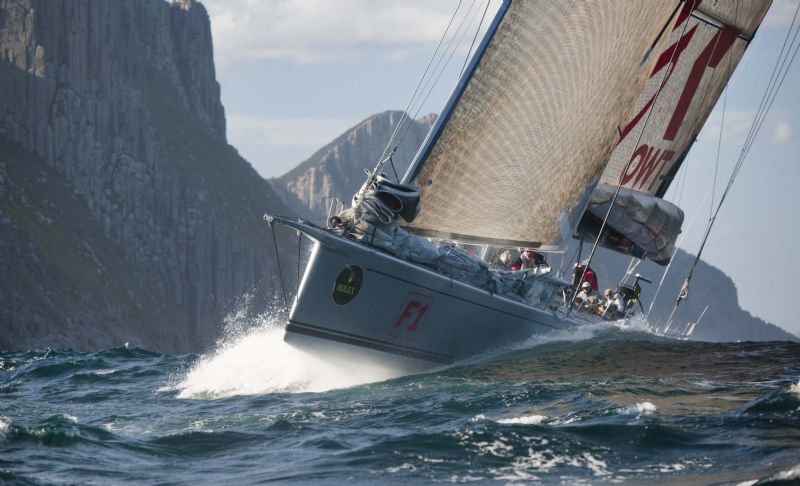 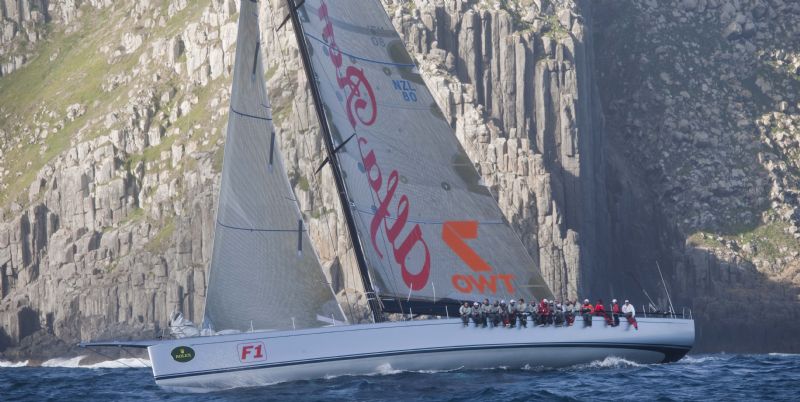
December 28, 2009
Rolex Sydney Hobart Race leader Neville
Crichton's Alfa Romeo leading over the final miles to the finish
of the 628 nautical mile classic and with a healthy 17nm advantage
over nearest rival Wild Oats XI faced a final hurdle -- a strong
sou'-wester that will give his weary crew a final hard upwind
workout.
Through another day of stop-start sailing,
Alfa retained the race lead she has held since clearing Sydney
Heads. Wild Oats XI, a near sister Reichel/Pugh 100ft maxi, passed
Mike Slade's ICAP Leopard and gained on Alfa, which had led her
by up to 30 miles throughout the morning.
The three supermaxis had opened a huge
80nm gap on the remainder of the fleet by emerging first from
calms and light air created by a high pressure ridge in Bass
Strait, then ran into more frustrating light patches off the
east coast of Tasmania.
Leopard, the heaviest boat of the three,
suffered most, down to just over a knot of boat speed at noon
while Alfa and Oats also lost time "parking" in the
soft spots.
Wild Oats XI passed Leopard and gained
on Alfa to be 13nm behind off Maria Island, 70nm from the finish,
with both yachts under spinnakers and traveling at about 14 knots
on a nor'-wester that swung northeast under the influence of
coastal sea breezes.
But the with the southwest change looming,
the race for line honours was not over, Crichton warned. "We
still have a lot of racing to do because we are 30 miles from
Tasman Island, with another 40 miles into the Derwent and the
forecast is for 20-30 knots on the nose, so anything can happen.
"It's difficult because we are going
to run into the southerly first and they are still under spinnaker.
I guess we will have to wait until we get into the sou'-wester
and see where they are, but we will certainly cover wherever
possible."
Australia's most respected yachting forecaster
Roger Badham sees another hurdle in the wind pattern: a curtain
of total calm descending on the Derwent River over the last 11nm
to the finish after 2100-2200 hrs.
Wild Oats XI tactician Iain Murray said
there were still opportunities to catch Alfa after rounding Tasman
Island. "It's a difficult part of the day; sailing into
the night. We're in a north-easter; we know there is a sou'-wester
around the corner, there will be a transition zone. It's been
a very challenging race, keeping the boat going the whole time,
obviously doing a lot of tacking and gybing, changing sails.
It keeps you right on your toes." 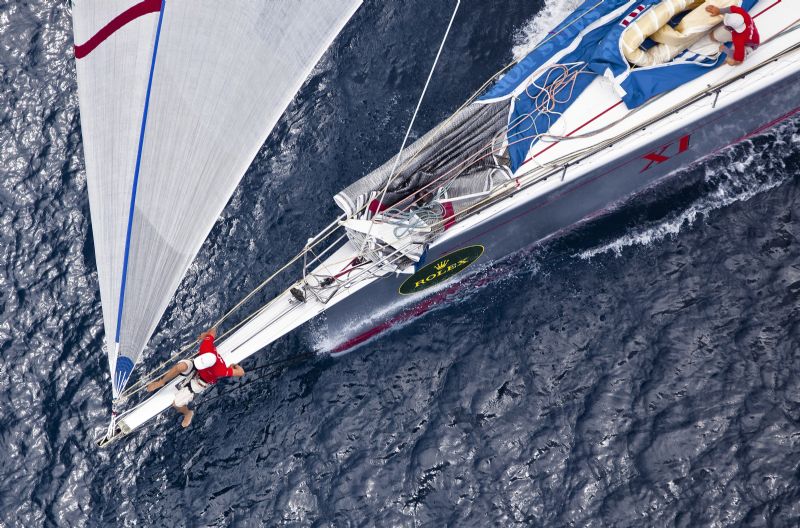
At 1800, Alfa was only 5nm from Tasman
Island, 17nm ahead of Oats and making 12.4 knots to Oats' 11.9
kn with Leopard another six miles behind.
The next-sized group of boats, the 50-70
footers, got going again through the day after clearing the Bass
Strait doldrums, to make fast progress in the nor'wester which
freshened to 15-20kn off Flinders Island and 20-25kn off Eddystone
Point at the north-eastern extremity of Tasmania.
On the final miles of the Bass Strait crossing
they reached at speeds of 15-17kn under reaching headsails and
staysails. One of them, the British Judel/Vrolijk 72 Ran (Niklas
Zennstrom), jumped to the top of the overall IRC handicap calculations
at 1800, followed by Yendys, Geoff Ross' Reichel/Pugh 55, the
TP52 Shogun (Rob Hanna), Reichel/Pugh 63 Loki (Stephen Ainsworth)
and Farr 55 Living Doll (Michael Hiatt). Alfa Romeo, which until
this morning had led the corrected time calculations, was back
in 16th place. But this group still had to traverse the light
patches along the Tasmanian coast.
For much of the day, the smaller boats
in the back end of the fleet remained stuck in the Bass Strait
doldrums or in light southerly headwinds. This afternoon Love
& War, the 1970s vintage Sparkman & Stephens 47 that
won the Tattersall's Cup IRC overall in the 2006 Rolex Sydney
Hobart Race in strong upwind conditions, was doing only 3.8kn
and was calculated to be 72nd on overall IRC corrected time.
Another 1970s S&S design, the 41-footer
Pinta-M (Atse Blei) from the Netherlands, was down to 2.7kn and
54th overall on IRC.
Ninety-five yachts are still racing,
from a fleet of 100 starters, with five boats retired. The Rolex
Sydney Hobart Yacht Race fleet has crews representing the USA,
UK, New Zealand, Spain, the Netherlands, and New Caledonia as
well as every Australian state.
ALFA GETS THE GUN AT 2009
ROLEX SYDNEY HOBART YACHT RACE
December 28, 2009
After sailing a near perfect tactical race
in extremely difficult conditions, with extremes from a testing
25-knot southerly, with a bumpy seaway through the first night,
to a calm in the notoriously rough and windy Bass Strait, Neville
Crichton's Alfa Romeo was first to finish in the 2009 Rolex Sydney
Hobart Race, with an elapsed time of two days, 9hrs, 2mins, 10secs
for the 628nm course.
The line honours win, with a Reichel-Pugh
designed canting keel 100-footer, was Sydney-based New Zealander
Crichton's second in the Rolex Sydney Hobart Race. His previous
win, in 2002, was with his first Alfa Romeo maxi, a water-ballasted
Reichel/Pugh 90.
Alfa, with good speed and crew work, as
well as tactics, led from the start, holding off all challenges
from her arch-rival Bob Oatley's R/P 100 Wild Oats XI, a very
similar design from the same builder, McConaghy Boats in Sydney,
launched only a few months apart in 2005, and Mike Slade's (UK)
Farr 100, ICAP Leopard.
Wild Oats XI won their first line honours
battle with Alfa in the 2005 Rolex Sydney Hobart Race by an hour
and 16 minutes. Crichton then took Alfa Romeo to the northern
hemisphere for the Mediterranean regattas in 2006 and 2007 where
Alfa and Oats swapped line honours wins until Wild Oats XI broke
her mast in the 2007 Maxi Yacht Rolex Cup in Porto Cervo and
was shipped back to Australia. This year's Rolex Sydney Hobart
was their first encounter since in a major offshore race.
Crichton's fears of slowing in a southwest
headwind in calms in the River Derwent over the last 11 nautical
miles to the finish were unfounded. She stalled only once in
a light patch and finally steamed home to get the finishing gun
at Battery Point just after 2200, with Wild Oats XI 17nm behind
(Wild Oats eventually finished just over two hours later.)
A crowd of several hundred people crowded
the Constitution Wharf marina to watch the finish and cheer Alfa
in to the dock. Asked, as Alfa Romeo berthed, how he was feeling,
Crichton said: "It's fantastic and the welcome here in Tasmania
is unbelievable."
He praised his crew, half of them New Zealanders
and half Australian: "The 22 guys I have are the best crew
in the world. The two days coming down the coast was hard work
and it was good; the boys did a helluva job on the boat and it
was very, very close racing."
Was the lack of wind frustrating? "Oh
no, we were very busy the whole race."
Did he see the win as sweet revenge for
the 2005 defeat by Wild Oats XI? "Every win is a good win.
It has taken me four years to come back and do it, so it was
even nicer. He added, "Winning the Rolex Sydney Hobart is
the ultimate in ocean racing."
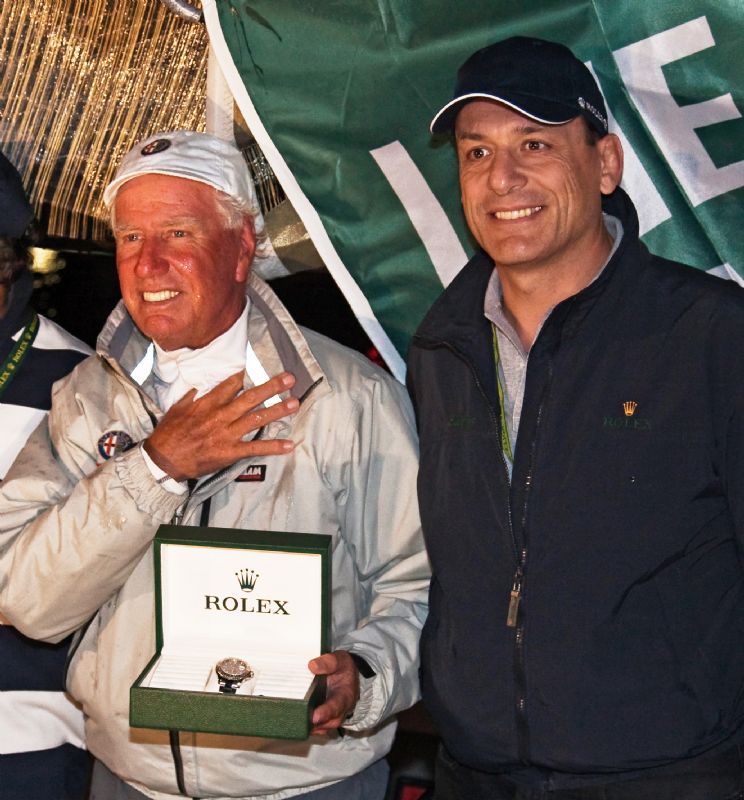
Crichton was presented with a Rolex Yacht-Master
timepiece and the JH Illingworth trophy for his line honours
win. The victory-pumped Crichton showed his mischievous sense
of humour at the dockside presentation; MC Steve Barker asked
Crichton if he had any message for the skippers of Leopard and
Wild Oats, who had challenged a couple of times. He raised a
big laugh with the answer and a gesture toward the River Derwent:
"Where ARE they?"
At 0015, ICAP Leopard was 35.6nm
from the finish making 8.6 kn. There were 93 yachts still to
finish from a fleet of 100 starters, with five retired.
LINE HONOURS PODIUM FILLS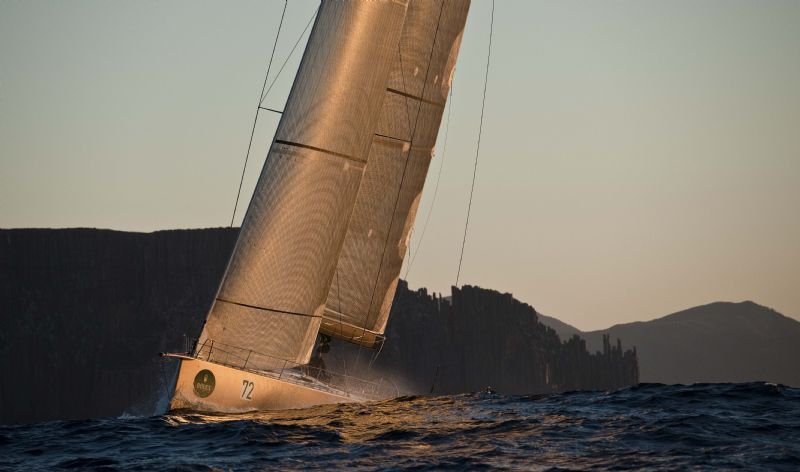
December 29, 2009
The 2009 Rolex Sydney Hobart Race line
honours podium filled this morning when Bob Oatley's Wild Oats
XI and Mike Slade's ICAP Leopard finished in second and third
positions.
Wild Oats XI finished at five minutes after
midnight, two hours and three minutes behind her Reichel/Pugh
100 near-sister yacht Neville Crichton's Alfa Romeo. Leopard,
a Farr 100, finished at 0545, five hours and 40 minutes behind
Wild Oats XI.
Next to finish, at 0734, was another 100ft
maxi, the Greg Elliott-designed Investec Loyal (Sean Langman),
which previously raced for New Zealand owners as Maximus.
Fifth home, at 0927, was Niklas Zennstrom's
Ran from the UK, a Judel/Volijk-designed 72-footer that was overall
handicap winner in the 2009 Rolex Fastnet Race.
Ran has a chance of winning the race's
major trophy, the Tattersall's Cup, for the first yacht on IRC
corrected time. She has certainly beaten Alfa Romeo, which led
the IRC overall standings for a time yesterday, denying Crichton
the rare handicap/line honours double.
Wild Oats' Mark Richards was gracious in
defeat. "It was a tactical race and we never got a look
in really," Richards said. "They had a little edge
on us on the first night and the next morning we were in a big
parking lot together. They got out first and put 30 miles on
us before we knew what had happened."
Mike Slade had an historical perspective
of the close three-way battle of the maxis: "When Napoleon
turned up at Waterloo he knew he was in for a bad day, he had
a bad day at the office didn't he? I've been a bit like that.
It was a fantastic race and well done Alfa, bloody marvellous."
Slade said that Leopard had gambled by
sailing farther offshore than Alfa and Oats down the east coast
of Australia rather than sailing in Alfa's wake. "We went
offshore because there was no point in covering Alfa's tracks;
she had about 20 miles on us and we just got locked out. We had
about four shut-downs and it was as frustrating as hell. We sat
there for hours, watching them go away. That cost us. We got
punished."
Rounding Tasman Island was the worst Slade
had experienced. "There was no wind and appalling seas;
really nasty because it's a lee shore, you've got no steerage
because there's no wind, but the seas were huge and that took
us a couple of hours.
"Alfa and Oats had already gone round.
The rich get rich and the poor get poorer, that's what the game's
all about. So it was a shocker but we loved every minute of it.
We will be back to do another one I think - the boat's a glutton
for punishment."
Ran, after performing well in the fresh
upwind work on the first night, parked in calms before zooming
back into handicap contention with a blistering run on the new
nor'-west breeze off Flinders Island.
Ran's owner/skipper Niklas Zennstrom said:
"The race at times was frustrating, we got parked up. Yesterday
afternoon we had a fantastic run, we were reaching at up to 24
knots of boat speed, averaging 18 and 19 knots. It was excellent
sailing.
"This morning was also very good;
last night we had a few stops and goes. But we are happy with
how the boat performed on corrected time and we will have to
wait and see how the other boats are going on handicap.
"At times it looked really, really
bad for us and really good for the small boats, but that's how
it is. All you can do is sail as good as you can and avoid making
as many mistakes as possible. I don't think we made too many
mistakes."
Ran's tactician Adrian Stead said that
after riding the nor'-wester fast, Ran hit a light spot last
evening, 20 miles northeast of Maria Island. "We got through
that and sailed the last bit up here pretty well, very conscious
that 10:20 was our deadline to beat Alfa," he said.
With six yachts finished, and five yachts
retired, there are 89 yachts still racing.
The Rolex Sydney Hobart Yacht Race
fleet has crews representing the USA, UK, New Zealand, Spain,
the Netherlands, and New Caledonia as well as every Australian
state.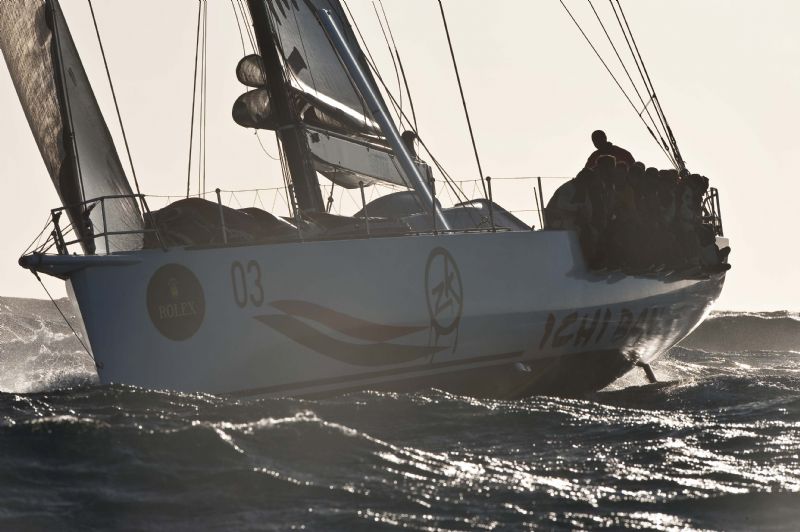
SOUTHERLY SLOW-UP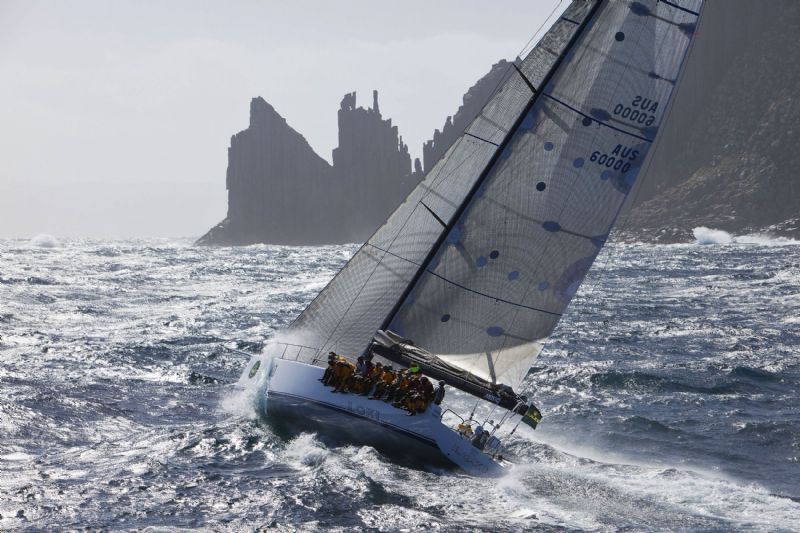
December 29, 2009
A strong southerly to southwesterly change
sweeping up the Tasmanian coast this afternoon slowed the 87
yachts still at sea in the 2009 Rolex Sydney Hobart Race.
At 1600, the Bureau of Meteorology issued
a strong wind warning for the lower east coast, from Wineglass
Bay to Tasman Island for southwest to southerly winds of 30 knots
in open waters at first, easing to 5 to 15 kn by late evening,
with two to three metre seas and a southwest swell of 2.5 to
3.5 metres.
The winds would then tend northeast to
northerly at 10 - 20kn during tomorrow morning before increasing
during the afternoon to 20 - 30kn by evening.
For the yachts covering the remaining miles
of the 628 nautical mile race, the forecast meant a bumpy, wet
night of tacking upwind before the strong northerly picks up
the fleet still at sea and propels them towards Tasman Island
at a very fast pace on a wild spinnaker ride.
That scenario removes any certainty about
the computer calculations of the likely winner of the Tattersall's
Cup for the overall IRC handicap winner.
But it is comforting for a leading contender
for the Tattersall's Cup, already tied up at the Kings Pier Marina
in Hobart. At 1800, Niklas Zennstrom's Judel/Vrolijk 72 Ran (UK),
was showing up in 15th position on corrected time calculations.
Ran's tactician, Adrian Stead, said: "We're
in good shape; we got Neville (Alfa Romeo) by 50 minutes or so,
which is good and we sailed really well. All we can do now is
wait and see how we shape up."
Also at 1800, Tony Kirby's X41 Patrice
6 was calculated to be leading IRC overall handicap from an eclectic
mix of designs and sizes. She was 12nm east of Cape Sonnerat,
between the coastal villages of Swansea and Triabunna, making
seven knots with 96nm to sail.
Second was Andrew Saies' Beneteau First
40 Two True, followed by Wicked (Mike Welsh), another Beneteau
First 40. Then came the Spanish entry Charisma (Alejandro Perez
Calzada), a 1970 Sparkman & Stephens IOR rule design that
should revel in the strong upwind conditions.
One IRC handicap result that is certain
is the win of Neville Crichton's 100ft super-maxi Alfa Romeo,
the line honours winner, in IRC division 0 for canting keel-powered
boats and the second place in that division for Matt Allen's
modified Jones-design Volvo 70, unbeatable in second place on
current position reports.
Allen said the Volvo 70 was a very good
boat for upwind and in high-wind pressure sailing. In the sou'-wester
of up to 25 knots on the first night, she worked up to within
a half mile behind Wild Oats XI.
"We were not overly surprised to see
that, but we knew the next night in the lighter airs and with
the bigger sails the maxis carry, giving away rating, they would
get through that first light-air gate. Only the three boats got
through and the next morning we were there with all our fellow-sized
boats stuck for five or six hours."
Allen said that every night there were
challenges. "You'd sail through the day, with quite a few
wind shifts, but generally the night-time sailing was tricky.
Every night we parked up. Tactically it was a very interesting
race, because you had to work out where you were going to get
through in the next transition.
"Last night we'd had a 30-knot nor'-westerly
and we were doing 25 knots, white water coming over the boat.
It lasted for an hour and-a-half and within minutes it went down
really quickly: to ten knots, to five and then zero. So we went
from having 30 knots to being in no wind with leftover swell
and you could only go in one direction, with the waves.
"The big transition zones had the
navigators really on their toes, playing the angles and trying
to work out how to handle the next transition."
With eight yachts finished, and
five yachts retired, there are 87 yachts still racing to the
finish in Hobart.
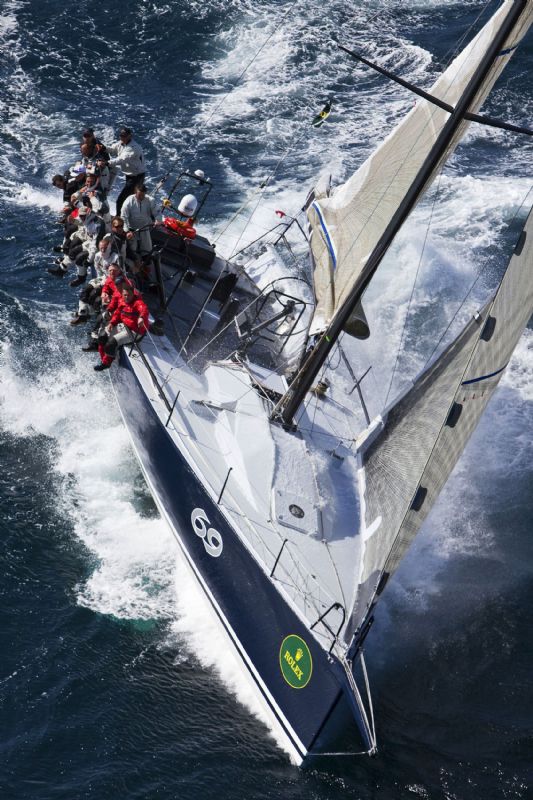 Shogun... Shogun... |
TATTERSALL's CUP STILL IN DOUBT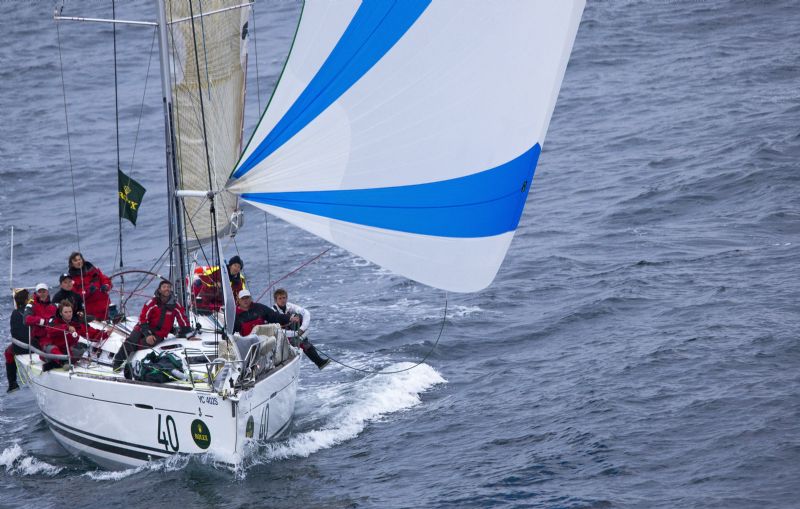
December 30, 2009
The smaller boats at the back of the Rolex
Sydney Hobart Race, after surviving frustrating light air and
calms off the southeastern coast of New South Wales, are blowing
home fast today.
A light but steady nor'easter in Hobart
this morning, has been giving the yachts finishing a comfortable
one-leg day over the last 11 nautical miles of the course up
the Derwent River.
The Bureau of Meteorology forecast for
the lower east coast of Tasmania has a light east-northeast breeze
this morning tending northeast-north during the morning and increasing
to reach 20-30 knots by this evening.
But the winner of the race's most prized
trophy, the Tattersall's Cup for the first boat on IRC overall
corrected, may still be in doubt after the finish.
At 1200, Andrew Saies' Beneteau First 40
Too True (photo above), from the Cruising Yacht Club of Australia,
was leading the IRC corrected time calculations from another
First 40, Wicked (Mike Welsh) from Sandringham YC.
Seventh was the British Judel/Vrolijk 72
Ran (Niklas Zennstrom), moored since finishing yesterday, at
the Kings Pier Marina.
Two True was 7.6nm from the finish doing
7 knots, looking set to cross over two hours inside the time
needed to win.
But, after finishing she still has to survive
a protest lodged against her by the Inglis 39 She's the Culprit
(Todd Leary) over an incident soon after the start in Sydney
Harbour. She's the Culprit, holed in a collision had to retire
immediately.
The weather pattern, with its heavy mix
of calms and light air before the northerly flow bringing the
small boats home fast, has not suited the 50-72 footers that
were most fancied in pre-race predictions.
Aboard one of smaller boats in this group,
the Corby 49 Audi Centre Melbourne (formerly Flirt), was Roger
Hickman who has sailed in 33 Hobart races, twice aboard Tattersall's
Cup winners.
Hickman described how the mid-fleet boats
were finally slowed by the southerly change, the final nail in
the coffin for their overall handicap chances. "We were
off Schouten Island, (102nm) from the finish, when it went hard
south with a good 28-30 knots of breeze for four or five hours.
Then it lightened up, but it got very bumpy off Maria Island.
"It was a tough night, cold but within
the realms of acceptability. It went straight south so we had
to tack into Maria, tack out, and back into Eaglehawk Neck and
chipped our way up to Tasman.
"Half an hour before we got to Tasman
the wind went a bit left. We just got to Tasman and then it was
just soft, five knots, six knots, and then halfway across Storm
Bay this little north-easterly came in, which I guess was the
saving grace because we could well still be out there for another
couple of hours."
The after-race beers with crew mates on
the dock this morning evoked sad memories for Hickman ... of
his partner and crewmate Sally Gordon who, along with the yacht's
skipper Andrew Short, died in the wreck of Short's Shockwave
on Flinders Islet during a Cruising Yacht Club of Australia overnight
coastal race in October.
"This is my 33rd Sydney Hobart; the
first one in 15 years without my mate Sal," he said. "And
it's a piss-off because you get so used to relying on people.
It's all about the camaraderie. It's not which Hobart you do;
it's whom you do it with. And you make some wonderful, wonderful
friends."
With 35 yachts finished, and five yachts
retired, there are 60 yachts still racing to the finish in Hobart.
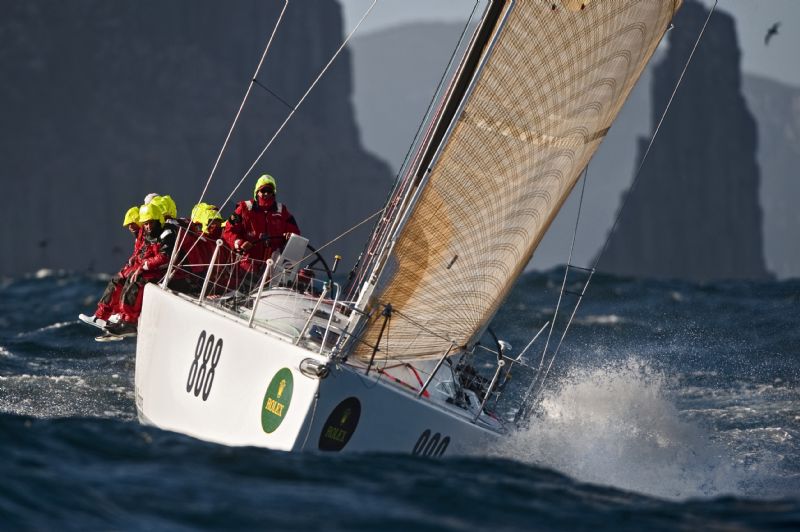
Below, Tow Truck! Go small, go now and
go bloody hard!
HANDICAP WINNER STILL IN BALANCE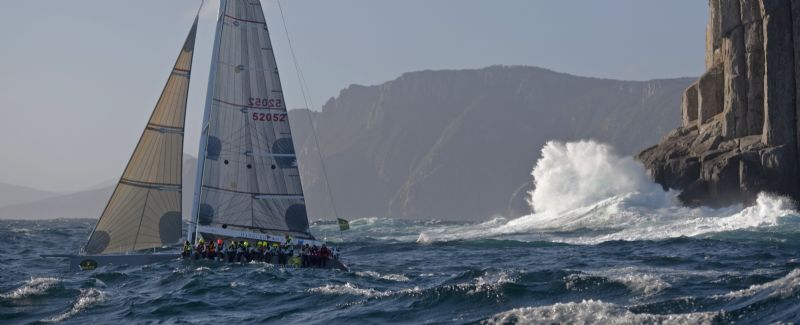 "shortwave" shown above "shortwave" shown above
December 30, 2009
The smallest boat in the fleet, Zephyr
Hamilton Elevators, was as of this evening, still well in the
running to win the IRC overall handicap division of the 2009
Rolex Sydney Hobart Race.
Zephyr is a Sea Nymph 33 co-owned by James
Connell and Alex Braddon from the Cruising Yacht Club of Australia.
She won division E in the 2007 Rolex Sydney Hobart Race.
The Sea Nymph 33 design is extremely fast
downwind and is well-suited to the strong northerly wind prevailing
on the lower Tasmanian east coast, forecast to reach 20-30 knots
by evening.
The final 40 nautical miles of the 628nm
course, with the northerly forecast to blow at 15-25 knots with
gusts to 30 knots, which will put Zephyr on the wind, and will
certainly slow and may end her chances of winning the Tattersall's
Cup for IRC overall handicap.
At 1550, Zephyr had 46 miles to go, and
was doing 9.7 knots for an estimated finish at 2311, well inside
the time she needed to take first place (0131 on Dec 31).
Second and third on corrected time standings
were two of Beneteau's new First 40s, which have already finished:
Two True (Andrew Saies) from the Cruising Yacht Club of South
Australia and Wicked (Mike Welsh) from Sandringham Yacht Club.
The Farr-designed First 40 is a replacement
for the successful Beneteau 40.7. A Beneteau 40.7, First National
Real Estate skippered by Michael Spies, was the overall handicap
winner of the 2003 Rolex Sydney Hobart Race.
Two True, in second spot, still has to
face a protest by the Tasmanian Inglis 39, She's the Culprit
(Todd Leary), which was badly damaged after the race start in
a jam of boats converging on the first rounding mark at Sydney
Heads and had to retire.
With some of the boats named in the protest
documents still racing, the International Jury has deferred the
protest until tomorrow morning (Dec 31).
Zephyr has also signaled by radio to the
race committee that she will lodge protests against three boats,
without specifying who they are, after finishing. That protest
could also arise from the crush of boats in the 100-boat fleet
converging to leave Sydney Harbour.
Two True and Wicked finished fast under
spinnakers before a moderate southeasterly sea breeze early this
afternoon, with Two True crossing 22 minutes ahead of Wicked.
Saies said: "It was a very difficult
and frustrating race. Having had a couple of light patches on
the way down, we thought we were through it and then we got a
third one, 25 miles from Tasman Light last night; around 3:00am
we were flapping around for three hours."
Tactician Brett Young said Two True had
followed a strategy of always being well east of the rhumbline
and had received a favourable push from the current in two major
eddies.
"Our routing was always east of the
rhumbline," said Young. "It's the first time I've ever
done that. And we had really good competition from Wicked. They
sailed hard, but we got through them. We really stuck to our
game plan, even with the weather not being anything like what
it was originally forecast. We only came into Tasmania when we
could lay Tasman Island."
Young said the First 40 had performed well
in the bumpy seaway following the southerly front. "Last
night was a tough night, but that's when this boat comes into
its own. In a seaway, it just goes faster."
Mark Welsh, boat manager and tactician
on Wicked for his owner-skipper father Mike Welsh, said: "We
chose the design after a lot of searching around the world for
one that would be very competitive in IRC racing and it looks
like we might have chosen successfully."
A third new First 40 was racing, Paca (Philippe
Mengual) from the Cruising Yacht Club of Australia. "So
our race really depended on watching the other two boats, said
Mark. "All credit to Two True, they sailed an absolutely
sensational race.
"On the second night out, even though
we were with them off Gabo Island, we couldn't hold them. They
sailed very, very well that night, got through us and from there
we were just playing catch-up and we couldn't catch them. They
did a great job."
The only IRC division decided, with all
boats finished, is Division 0 for canting-keeled boats. The line
honours winner Alfa Romeo (Neville Crichton), a Reichel Pugh100,
won from the Cookson 50 Evolution Racing (Ray Roberts), with
the modified Jones Volvo 70 Ichi Ban (Matt Allen) third.
With 48 yachts finished, and five yachts
retired, there are 47 yachts still racing to the finish in Hobart.
 |

 Rolex Sydney Hobart 2009!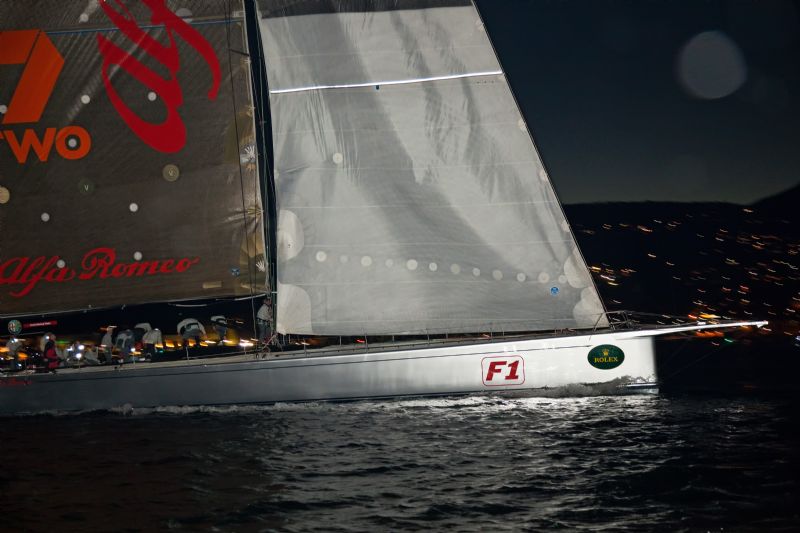
 Scroll Down For The Latest
News
Scroll Down For The Latest
News